Kata vs Traditional Containers
- RNREDDY

- Nov 26, 2025
- 2 min read
Kata vs Traditional Containers
Kata Containers is now one of the leading methods for running containers inside isolated virtual machines.
What are Kata Containers?
Kata Containers perform like containers, but provide the workload isolation and security advantages of VMs. It combines the benefits of containers and VMs.
The project is managed by the OpenStack Foundation.
With Kata, you can implement VM isolation at the container level and container isolation using hardware virtualization.
However, in Kubernetes, VM isolation applies at the pod level rather than individual containers.
As you can see in the above image, Kata Containers run each container inside its own virtual machine (VM) with a separate Linux kernel, providing stronger isolation.
In contrast, traditional containers share a single Linux kernel and use namespaces and cgroups for isolation. This highlights the key difference in how they handle security and isolation.
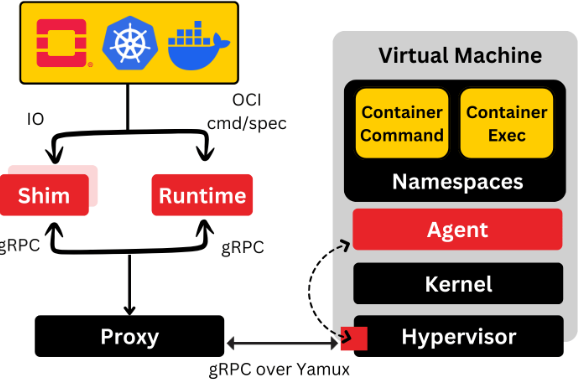
The architecture consists of six key components:
Agent: Manages container execution and communication inside the virtual machine.
Runtime: Executes container lifecycle commands, following OCI specifications.
Proxy: Facilitates communication between the runtime and the virtual machine through gRPC.
Shim: Provides compatibility for handling I/O and process management specific to each application.
Kernel: The virtual machine’s operating system kernel, ensuring isolated environments for containers.
Hypervisor (QEMU): Provides hardware virtualization, isolating containers in lightweight virtual machines.
Why Kata Containers are better Secured ?
Conventional containers pose security risks because they share the same OS kernel, network, and memory. A single compromised container can expose all others on the same system.
Kata Containers improve security by running each container in its own virtual machine with a dedicated kernel, isolating processes, network, and memory. They also use hardware-based isolation with virtualization extensions, adding an extra layer of protection.
Points to Consider:
Only available on Linux distributions.
CentOS
Debian
Fedora
Ubuntu
OpenSUSE
Red Hat Enterprise Linux
Still in early development, but widely adopted with promising technical foundations.
Supports Kubernetes, Docker, OCI, CRI, CNI, QEMU, KVM, and OpenStack.
Installation and more details here
Kata containers are best for situations where containers need to run on different kernels, like in CI/CD, edge computing, virtualized networks, and containers as a service (CaaS).


Comments